Should I Get a Second Opinion Before Shoulder Surgery?
should-i-get-a-second-opinion-before-shoulder-surgery
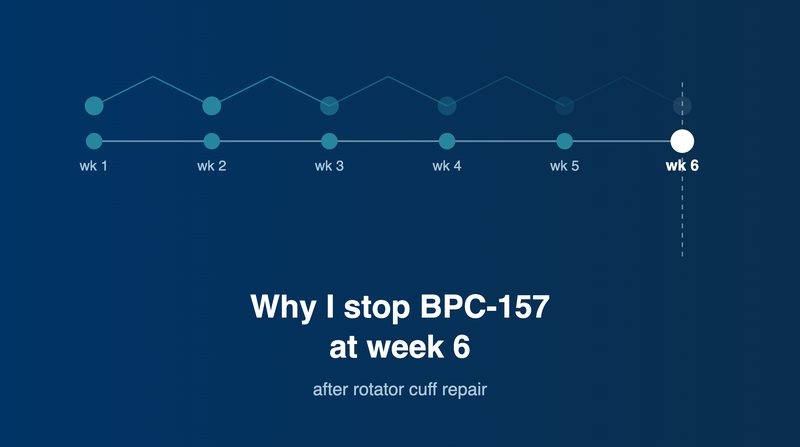
One of the most common questions I get from patients who've researched peptide protocols online is about duration: how long should you run BPC-157 after rotator cuff surgery? The answers floating around online range from 8 weeks to 6 months, often without any mechanistic rationale attached. My answer is week 6 — and the reason matters as much as the number.
Rotator cuff healing after surgical repair follows a predictable biological sequence. Understanding these phases is essential to understanding why timing any intervention — whether it's physical therapy, nutrition, or peptide signaling — matters.
Inflammatory phase (days 0–7). Immediately after repair, the body initiates a controlled inflammatory response. Cytokines flood the repair site, initiating cellular recruitment. This phase is necessary — suppressing it entirely is counterproductive. Neutrophils and macrophages clear debris and begin laying the groundwork for repair.
Proliferative phase (weeks 2–6). This is the most active healing window. Fibroblasts proliferate, type III collagen is synthesized, and new vasculature is established. The scaffold of the repair is being built. This is the window where interventions that support fibroblast activity and angiogenesis have the greatest potential impact.
Remodeling phase (weeks 6–52+). Type III collagen is gradually replaced by stronger type I collagen. Fiber organization improves. Mechanical properties of the repair mature over months. This process continues for up to a year.
BPC-157's primary documented mechanisms — VEGFR2-mediated angiogenesis, tendon fibroblast proliferation, and targeted anti-inflammatory modulation — are most relevant to the proliferative phase. This is when new blood vessels are being recruited, fibroblasts are actively laying down collagen, and the scaffold of your repair is being constructed.
By week 6, the proliferative phase is winding down. The biological processes that BPC-157 most directly supports are transitioning from active construction to organizational remodeling. Continuing the compound beyond this window isn't supported by the mechanism — you're no longer in the phase of healing it was designed to augment.
The remodeling phase has its own biology — collagen crosslinking, fiber orientation, mechanical loading adaptation. The appropriate interventions shift accordingly: progressive loading through physical therapy, adequate protein intake, and compounds that support collagen maturation rather than fibroblast proliferation.
There's a cultural bias in the peptide and biohacking world toward longer protocols. If 6 weeks is good, 12 weeks must be better. This logic doesn't hold when you're dealing with a biological system that has distinct phases with distinct needs.
Prolonged signaling of fibroblast proliferation beyond the appropriate window can theoretically promote disorganized collagen deposition — the same pathway that, in excess, contributes to fibrosis. The goal in rotator cuff healing is organized, high-tensile-strength collagen — not simply more collagen. Stopping BPC-157 at the end of the proliferative phase respects that distinction.
There's also a practical dimension: every compound you continue beyond its mechanistic rationale introduces ongoing cost, ongoing injection burden, and ongoing exposure to a compound whose long-term effects in humans remain unstudied. Cleaner is better when the biology supports it.
Week 6 is also a meaningful clinical checkpoint in my rotator cuff repair patients independent of any peptide protocol. Imaging and clinical assessment at this timepoint give me early signal on healing trajectory. In patients pursuing perioperative optimization protocols, lab work — including inflammatory markers, IGF-1 levels if relevant to their protocol, and nutritional markers — provides objective context for how the healing environment is progressing.
The transition at week 6 isn't the end of a recovery protocol — it's a phase shift. Compounds targeting angiogenesis and fibroblast activity step back; interventions supporting collagen maturation, progressive mechanical loading, and systemic anabolic signaling become the priority.
If you encounter a BPC-157 protocol with no defined endpoint, or one that runs for 3–6 months without a mechanistic rationale for duration, that's a signal to ask hard questions. Responsible perioperative peptide use requires understanding what biological process you're targeting, when that process is most active, and when it transitions to something else. The protocol should follow the biology — not the other way around.
⚠️ Medical Disclaimer: This content is for educational purposes only and does not constitute medical advice. BPC-157 and other peptides discussed here are not FDA-approved for these indications. Always consult your physician before starting any peptide protocol.
Keep reading
should-i-get-a-second-opinion-before-shoulder-surgery
is-a-cortisone-shot-in-the-shoulder-worth-it
can-a-torn-labrum-in-the-shoulder-heal-on-its-own
Oregon Shoulder Institute
massive-rotator-cuff-tear-with-severe-muscle-damage-repair-or-replacement
Book a consultation in Medford or Grants Pass, or send your MRI for a second opinion from anywhere in the country.