Medford & Grants Pass, OregonCall 541-608-2595Request an Appointment
Menu

Our Services

Elbow care from surgeons who specialise in the upper limb

The elbow is small, superficial and unforgiving. Most problems we see respond to non-operative care - and when they do not, the operation should be precise.

What we treat

Common elbow problems

Tennis & Golfer's Elbow

Epicondylitis causes pain over the inner or outer elbow that worsens with gripping. Most cases settle without surgery.

Elbow Bursitis

Swelling over the point of the elbow, sometimes painless. Aspiration, splinting or excision depending on cause.

Ulnar Nerve Compression

Numbness in the ring and little fingers, often worse at night. Release or transposition relieves pressure on the nerve.

Elbow Dislocation

Ligament injury after a fall on an outstretched hand. Early motion protects against long-term stiffness.

Elbow Stiffness & Impingement

Arthroscopic debridement or synovectomy to restore motion after arthritis or injury.

Elbow Arthroscopy

Minimally invasive assessment and treatment of loose bodies, spurs and cartilage damage.

Our approach

Non-operative first, and we mean it

The large majority of tennis elbow, bursitis and early nerve compression settles with activity modification, bracing, targeted therapy and time. We will tell you when that is the honest answer.

When surgery is warranted, most elbow procedures here are arthroscopic or performed through small incisions, with motion started early to protect against stiffness - the elbow's most common complication.
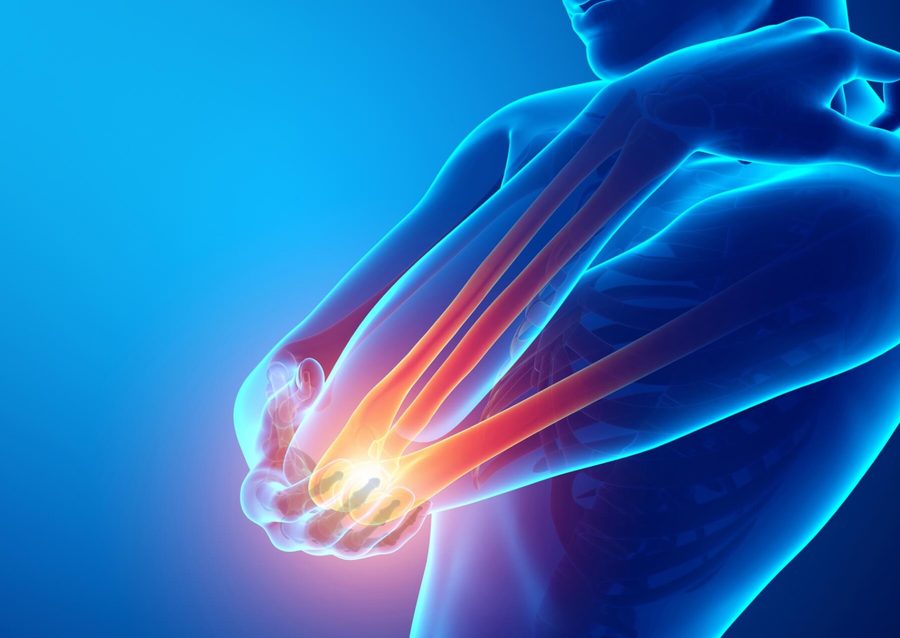
Anatomical illustration of the elbow joint and tendons

Elbow services are provided by Dr. Phillips

Anatomy

The anatomy of the elbow

The elbow is a synovial hinge joint made up of bone, cartilage, and ligaments that can twist and enable rotation of the hand. It is a complex joint that connects the two bones of the forearm, the ulna and radius, to the upper arm bone, the humerus. The radius is smaller than the ulna and connects to the wrist on the same side as the thumb. The lower end of the humerus bone flares out into two rounded protrusions called epicondyles, where muscles attach.

The two joints of the elbow

The elbow consists of two joints: the ulnohumeral joint creates the hinge between the humerus and the ulna allowing the arm to bend and straighten. The olecranon joint connects the upper part of the ulna, cupping the distal humerus.

Nerves and vessels of the elbow

The elbow is crossed by important nerves and vessels for the function of the upper extremity and is the origin of the flexor–pronator and extensor–supinator musculatures of the forearm. All the nerves that travel down the arm pass across the elbow. Three main nerves begin together at the shoulder: the radial nerve, the ulnar nerve, and the median nerve. These nerves are responsible for signaling your muscles to work and to relay sensations such as touch, pain, and temperature.

The ulnar nerve runs just below the skin at the elbow's “funny bone,” which is a part of the humerus. The radial nerve supplies the triceps, wrist extensors, and most of the back of the hand, while the median nerve passes down the inside of the arm and crosses the front of the elbow. At the wrist it goes through a tunnel, referred to as the carpal tunnel, made up of the wrist bones and a tough band of connective tissue.

Joint capsule and bursae

Like all synovial joints, the elbow joint has a capsule enclosing the joint. The joint capsule is thickened medially and laterally to form collateral ligaments, which stabilize the flexing and extending motion of the arm. The elbow bursa is a thin fluid-filled membranous sac filled with synovial fluid that is located at the bony tip of the elbow (the olecranon). It acts as a cushion to reduce friction between the moving parts of a joint, limiting degenerative damage.

Ligaments of the elbow

An extensive network of ligaments surrounding the joint capsule helps the elbow joint maintain its stability and resist mechanical stresses. The main ligaments of the elbow are:

Radial collateral ligament
Or lateral collateral ligament, which lies on the lateral surface of the joint and connects the humerus with the ulna and with the annular ligament. This ligament is generally triangular in shape.
Ulnar collateral ligament
Or medial collateral ligament, which lies on the medial surface of the joint and connects the inner end of the ulna with the inner end of the humerus.
Annular ligament
Which wraps around the radial head (the word annular means “ring-shaped”). The annular ligament cinches the radius to the ulna without interfering with the rotation of the radial head.
Posterior ligament
Which lies on the posterior surface of the joint and attaches the end of the ulna with the humerus.
Anterior ligament
Which lies on the anterior surface of the joint.
Muscles and tendons surrounding the elbow

The muscles and tendons surrounding the elbow make it possible for the arm to move. The two main muscles responsible for bending and straightening the arm at the elbow are:

Triceps
Located at the back of the arm.
Biceps
Located at the front of the arm.

The main muscles of the elbow involved in wrist and finger movement are:

Flexors
Which attach to the inside of the elbow and enable you to bend your wrists and fingers.
Extensors
Which attach to the outside of the elbow and enable you to extend or straighten your wrists and fingers.

Several tendons connect the muscles and bones of the elbow. The primary tendons are:

Biceps tendon
Which attaches the biceps on the front of the arm to the radius, enabling you to forcefully bend your elbow.
Triceps tendon
Which attaches the triceps to the ulna, enabling you to forcefully straighten your elbow.

Conditions

Elbow conditions

Golfer’s elbow

Tennis elbow or lateral epicondylitis is a painful condition involving the tendons that attach to the bone on the outside (lateral) part of the elbow. The muscles involved in this condition help to straighten and stabilize the wrist.

Learn more →

Ulnar nerve compression

Cubital tunnel syndrome happens when the ulnar nerve (also known as the “funny bone” nerve), which passes through the cubital tunnel — a tunnel of muscle, ligament, and bone on the inside of the elbow — is injured and becomes inflamed, irritated, and swollen.

Learn more →

Arthritis

Arthritis is a painful inflammation and stiffness of the joint that can affect any joint in the body. This includes the elbow and shoulder. The most common forms of arthritis are osteoarthritis, post-traumatic arthritis (after an injury), and rheumatoid arthritis.

Learn more →

Elbow dislocation

An elbow dislocation occurs when the bones of the forearm (the radius and ulna) move out of place compared with the bone of the upper arm (the humerus). The elbow joint becomes dislocated, or out of joint.

Learn more →

Bone spurs

Bone spurs (also known as osteophytes) are bony projections that develop on the surface of the bone, and are often the result of osteoarthritis. They often pop up in the joints — the places where two bones meet.

Learn more →

Elbow bursitis

Elbow bursitis occurs in the olecranon bursa, a thin, fluid-filled sac located at the bony tip of the elbow. The bursae located throughout the body act as cushions between bones and soft tissues, such as skin. They contain a small amount of lubricating fluid that allows the soft tissues to move freely over the underlying bone. If the olecranon bursa becomes irritated or inflamed, more fluid will accumulate in the bursa and bursitis will develop.

Learn more →

Shoulder instability

A dislocation occurs when the end of the humerus (the ball portion) partially or completely dislocates from the glenoid (the socket portion) of the shoulder.

Learn more →

Procedures

Elbow procedures we perform

Elbow arthroscopic debridement

Elbow arthroscopy is a minimally invasive procedure to inspect, diagnose and repair problems inside the elbow joint. It involves thoroughly cleaning the wound and removing all hyperkeratotic (thickened skin or callus), infected, and nonviable (necrotic or dead) tissue, foreign debris, and residual material.

Learn more →

Elbow bursitis surgery

Elbow bursitis surgery is used to treat bursitis caused by infection if less invasive treatments, such as antibiotic treatment and removing fluid from the bursa, have not helped relieve symptoms. Surgery is rarely used for noninfectious bursitis.

Learn more →

Elbow impingement surgery

Elbow impingement surgery is needed when there is compression and injury of soft tissue structures, such as cartilage, at the back of the elbow or within the elbow joint. It is caused by repetitive forced extensions and overuse. It can either occur in isolation or in athletes in overhead-throwing sports like baseball, football, volleyball, and tennis.

Learn more →

Epicondylitis surgery — tennis elbow surgery

Epicondylitis surgery is a procedure to alleviate the pain and inflammation caused by epicondylitis, an inflammatory process that may be more accurately described as tendinosis. Also known as tennis or golfer's elbow, the condition is widely believed to originate from repetitive overuse with micro tearing and progressive degeneration.

Learn more →

Elbow synovectomy

Elbow synovectomy surgery removes inflamed joint tissue (synovium) that is causing unacceptable pain or limiting function or range of motion. Ligaments and other structures may be moved aside to access and remove the inflamed joint lining. The procedure may be done using arthroscopy.

Learn more →

Ready to get a clear answer about your shoulder?

Book a consultation in Medford or Grants Pass, or send your MRI for a second opinion from anywhere in the country.