Should I Get a Second Opinion Before Shoulder Surgery?
should-i-get-a-second-opinion-before-shoulder-surgery
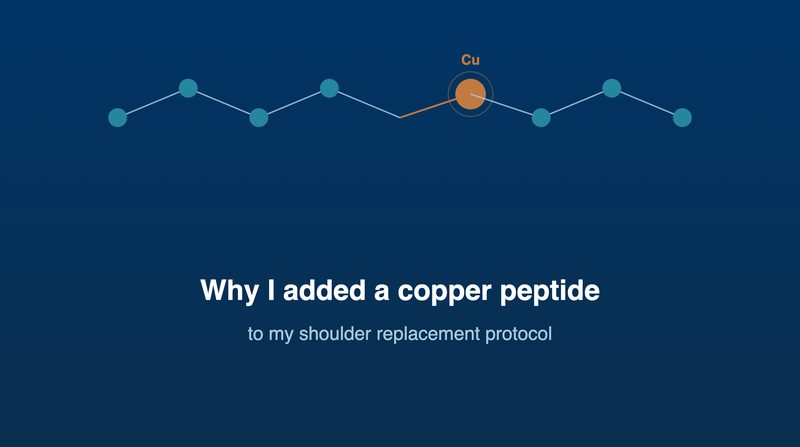
Shoulder arthroplasty is a fundamentally different healing challenge than rotator cuff repair. A cuff repair is primarily about tendon-to-bone biology. A shoulder replacement involves that biology too — the subscapularis repair is a critical component of recovery — but it adds an incision, a soft tissue dissection, implant osseointegration, and a wound healing requirement that rotator cuff repair generally doesn't. When I started building a comprehensive perioperative optimization protocol for shoulder arthroplasty patients, GHK-Cu emerged as a compound that addressed a specific gap in the wound healing dimension.
GHK-Cu is a naturally occurring copper-binding tripeptide — three amino acids (glycine, histidine, lysine) complexed with a copper ion. It was first isolated from human plasma in the early 1970s and has been studied across a wide range of biological contexts since. Its serum levels decline significantly with age, which has generated interest in both aesthetic medicine and clinical regenerative applications.
The copper component isn't incidental. Copper is essential for lysyl oxidase activity — the enzyme responsible for crosslinking collagen and elastin fibers. Without adequate copper, collagen synthesis proceeds but the resulting matrix is structurally weaker. GHK-Cu's copper delivery function is directly relevant to the quality, not just the quantity, of healing tissue.
A shoulder arthroplasty incision goes through multiple tissue layers: skin, subcutaneous tissue, deltopectoral fascia, and deep layers depending on approach. Each layer has its own healing requirements, and each benefits from the same core biological processes: collagen synthesis, organized fiber deposition, angiogenesis, and controlled inflammatory resolution.
GHK-Cu has documented effects on all of these. It upregulates collagen and glycosaminoglycan synthesis in fibroblasts, promotes angiogenesis through mechanisms overlapping with but distinct from BPC-157, modulates matrix metalloproteinase (MMP) activity to prevent excessive collagen degradation, and has anti-inflammatory properties at concentrations relevant to topical application.
The combination of collagen synthesis stimulation and MMP modulation is particularly important for wound healing quality. You want new collagen being laid down efficiently, but you also want the remodeling enzymes that break down and reorganize collagen to be appropriately regulated — not suppressed entirely, but not running unchecked.
GHK-Cu is available in both injectable and topical formulations. For the arthroplasty wound healing indication specifically, I think topical application makes the most biological sense. The target tissue is the incision site and the surrounding skin — a layer directly accessible to a topical compound. Delivering GHK-Cu where you need it, in a concentration relevant to the biology, without requiring systemic distribution.
Injectable GHK-Cu operates systemically and is more relevant to deeper tissue and anabolic signaling applications. For incision site wound healing, topical application concentrates the signal where the healing demand is highest. It's also simpler, better tolerated, and has a well-established safety profile in the cosmetic dermatology literature — which, despite the different application context, represents a meaningful body of human-use data.
GHK-Cu has an extensive history in skincare and aesthetic medicine. Clinical studies in that context have demonstrated improvements in skin thickness, collagen density, fine line reduction, and wound healing after cosmetic procedures. This data is real and methodologically reasonable — it just comes from a different population and application context than perioperative shoulder surgery.
I reference this data not as direct evidence for surgical use, but because it establishes an important baseline: GHK-Cu has been applied topically to human skin with favorable effects and an excellent safety profile across a substantial body of literature. That's meaningfully different from a compound whose only data comes from rat injection studies.
In my arthroplasty perioperative optimization framework, GHK-Cu topical addresses the incision and superficial soft tissue layer — a dimension that other compounds in the protocol don't specifically target. BPC-157 covers the deeper tendon and angiogenesis biology. CJC-1295/ipamorelin supports the systemic anabolic environment and IGF-1 signaling for bone and muscle. GHK-Cu handles the interface between the surgical site and the outside world: the wound itself.
This isn't redundancy — it's coverage of distinct biological targets. Good perioperative optimization is about identifying the specific biological challenges of a given procedure and addressing them with appropriate, mechanistically-matched interventions. Shoulder arthroplasty creates a wound healing demand that cuff repair doesn't to the same degree. GHK-Cu is the answer to that specific demand.
Not every patient undergoing shoulder replacement is a candidate for or interested in peptides. For those who are, GHK-Cu is one of the easier conversations to have — the compound is familiar from aesthetics, the topical application is straightforward, the safety profile is well-established, and the biological rationale connects directly to something patients can see and feel: how their incision heals.
For patients who are interested in the broader protocol, GHK-Cu is often the entry point — the piece they're most comfortable with. And that's fine. A single well-chosen intervention is better than a poorly understood stack. We build from there based on the patient's goals, their baseline labs, and the specific demands of their surgical recovery.
⚠️ Medical Disclaimer: This content is for educational purposes only and does not constitute medical advice. BPC-157 and other peptides discussed here are not FDA-approved for these indications. Always consult your physician before starting any peptide protocol.

Keep reading
should-i-get-a-second-opinion-before-shoulder-surgery
is-a-cortisone-shot-in-the-shoulder-worth-it
can-a-torn-labrum-in-the-shoulder-heal-on-its-own
Oregon Shoulder Institute
massive-rotator-cuff-tear-with-severe-muscle-damage-repair-or-replacement
Book a consultation in Medford or Grants Pass, or send your MRI for a second opinion from anywhere in the country.