Oregon Shoulder Institute
Rotator Cuff Repair Outcomes: Dr. Patrick Denard's Published Results
rotator-cuff-repair-outcomes-dr-patrick-denard

Short answer: A rotator cuff repair that has torn again doesn't always need another operation, and Dr. Patrick Denard of Oregon Shoulder Institute recommends revision mainly when pain or weakness continues despite nonsurgical care and the odds of healing are reasonable. When surgery is needed, the options range from a second arthroscopic repair to superior capsular reconstruction, a tendon transfer or a reverse shoulder replacement.
If your repair didn't hold, this is worth knowing first. Some people have a re-tear on their MRI and still have a shoulder that works well and doesn't hurt much. Function can be maintained despite a recurrent tear, and a recurrent tear on its own is not a reason to operate again (Denard 2011, PMID 22052642).
What matters is how you feel and what you can do. The main reason to consider revision is pain or weakness that persists despite nonsurgical treatment, when you don't have major risk factors that would make the second repair likely to fail as well (same source).
Repairs fail for two broad groups of reasons. Some come from the patient and the tear: age, the size of the tear, and the quality of the tendon and muscle. Others come from outside: the surgeon's experience with these operations and mechanical failure of the repair itself (Denard 2011, PMID 22052642). Before I recommend anything, I want to understand which of these happened to you, because it changes what the next step should be.
Often, yes. When my colleagues and I reviewed the published studies on failed repairs, conservative treatment looked reasonable for most patients, especially when the re-tear is at the back and top of the cuff and motion was poor before surgery. Revision was more likely to make sense in younger patients with a tear that can still be repaired, in three-tendon tears, and when the subscapularis tendon at the front of the shoulder is involved (Lädermann 2016, PMID 27134759).
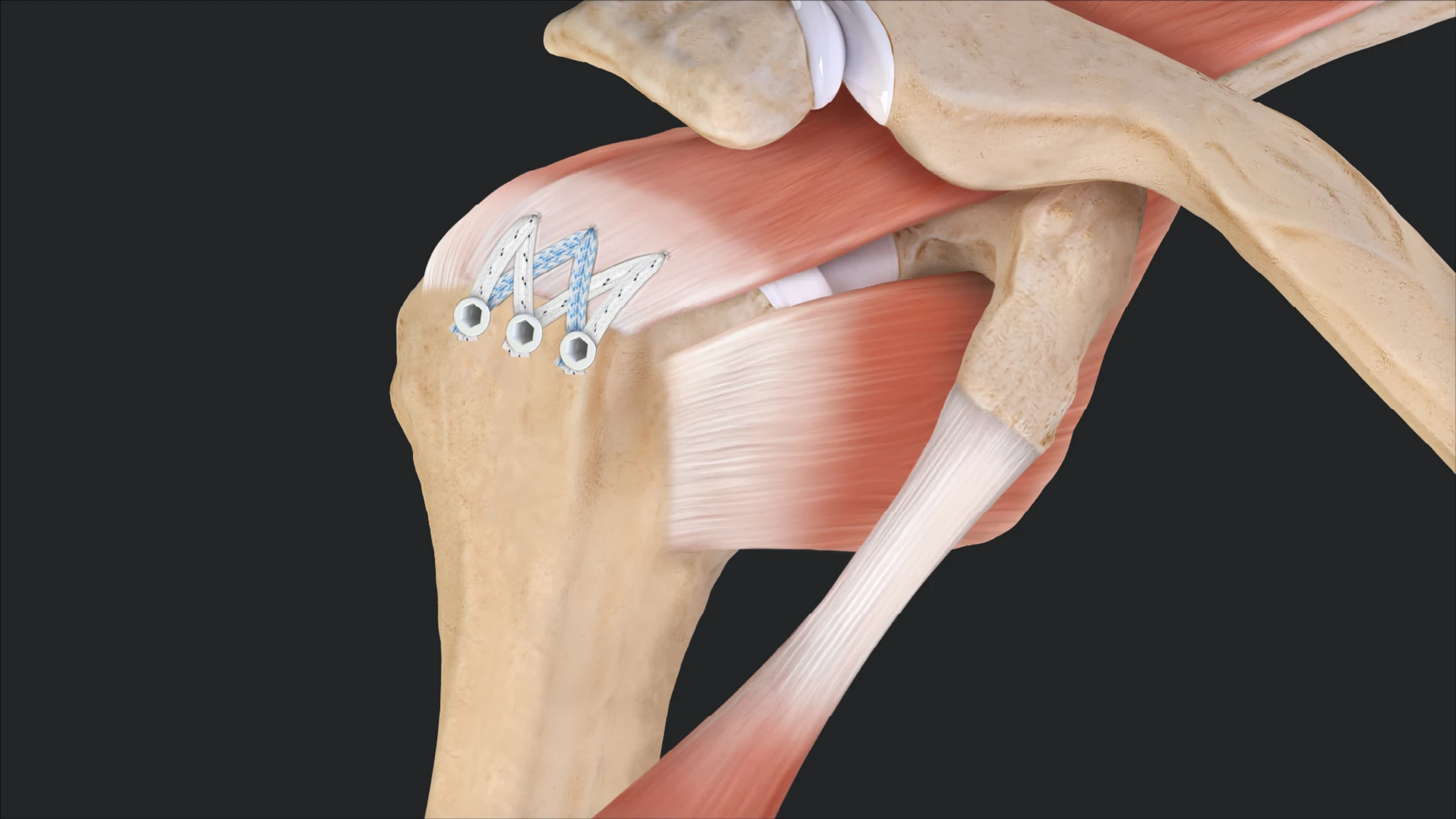
1. A second arthroscopic repair. If the tendon still has good tissue and can reach the bone, repairing it again is usually the first choice. In a study of arthroscopic revision repairs (21 non-massive and 53 massive re-tears) followed for an average of 63 months, satisfaction was 78%, and the size of the re-tear didn't change the final result (Lädermann 2011, PMID 22036765). In that same study, women, patients who could lift the arm less than 136 degrees before surgery, and those with pain above 5 out of 10 were less likely to have a good result (same source).
2. Superior capsular reconstruction (SCR). When the tendon can't be repaired again but the joint has little arthritis, a graft can rebuild the top of the shoulder capsule. It can work after a failed repair, though results are better when SCR is the first operation. In 350 patients followed for two years, greater improvement was seen when SCR was done as a primary procedure rather than as a revision after a failed repair (Hammad 2022, PMID 34052377). In my first multicenter SCR series, 42.4% of the 59 patients had already had a rotator cuff repair (Denard 2018, PMID 29146165).
3. Tendon transfer. A nearby tendon is moved to take over the job of the torn one. This is an option for younger patients whose tear can't be repaired (Jackson 2022, PMID 34767956).
4. Reverse shoulder replacement. If arthritis has set in, or the shoulder has lost the ability to lift the arm and other options are unlikely to work, a reverse replacement is often the next step. A prior repair doesn't ruin that option, but it does add risk. In a review of reverse replacements for massive tears without arthritis (343 first-time and 95 after a prior repair), function was similar whether or not patients had a prior repair, but the prior-repair group had a higher risk of complications (relative risk 6.26) and revision (relative risk 3.91) (Ardebol 2024, PMID 38403192).
Some patients can't raise the arm above shoulder height even though the shoulder moves freely when someone else lifts it. This is called pseudoparalysis. A first-time repair reversed it in 90% of 39 patients, but in 14 patients having a revision repair, only 43% regained the ability to lift above shoulder level (Denard 2012, PMID 22608887). That difference is why I am more careful about recommending a second repair when the arm has stopped working, and why SCR or a reverse replacement may come up sooner in that situation.
Dr. Patrick J. Denard is a fellowship-trained shoulder surgeon and the founder of Oregon Shoulder Institute in Medford, Oregon. He has performed more than 10,000 shoulder surgeries. PubMed lists more than 300 of his peer-reviewed papers, over 130 of them on the rotator cuff, including studies of revision repair and of superior capsular reconstruction, whose 2016 arthroscopic technique papers he co-authored with Dr. Stephen Burkhart and Dr. Christopher Adams. Expertscape ranked him #2 in the world for rotator cuff repair in 2021 and seventh in the world in 2023.
No. Many people with a re-tear keep reasonable function and manage with therapy. Dr. Denard considers revision mainly when pain or weakness persists despite nonsurgical treatment and the tendon has a reasonable chance of healing.
Often, yes, if the tendon still has usable tissue. In one study of 21 non-massive and 53 massive re-tears repaired again arthroscopically, 78% of patients were satisfied at an average of 63 months (Lädermann 2011, PMID 22036765).
Results are generally lower than after a first repair, especially when the arm can no longer lift. In one study, only 43% of revision patients with pseudoparalysis regained the ability to lift above shoulder level, compared with 90% of first-time repairs (Denard 2012, PMID 22608887).
Superior capsular reconstruction, a tendon transfer or a reverse shoulder replacement may be options. The choice depends on arthritis, whether the arm can lift, your age and your goals.
A prior repair is linked to a higher risk of complications and revision after a reverse replacement, though function ends up similar on average (Ardebol 2024, PMID 38403192).
Yes. Send your MRI through the remote MRI review and he will record a narrated video explaining what he sees and what he would recommend.
If you have an MRI taken after your repair, Dr. Denard can review your images and report remotely and send you a narrated video explaining what he sees and what he would recommend, typically within 48 hours, for $250. Start a remote MRI review. To be seen in person in Medford or Grants Pass, request an appointment or call 541-608-2595.
This page is for education and is not a substitute for an exam. Study results describe groups of patients and are not a guarantee of any individual result.
Keep reading
Oregon Shoulder Institute
rotator-cuff-repair-outcomes-dr-patrick-denard
Oregon Shoulder Institute
rotator-cuff-repair-recovery-week-by-week
Oregon Shoulder Institute
irreparable-rotator-cuff-tear-superior-capsular-reconstruction
Oregon Shoulder Institute
failed-rotator-cuff-repair-revision-options
Book a consultation in Medford or Grants Pass, or send your MRI for a second opinion from anywhere in the country.