Oregon Shoulder Institute
Rotator Cuff Repair Outcomes: Dr. Patrick Denard's Published Results
rotator-cuff-repair-outcomes-dr-patrick-denard

Short answer: Not always, but often. Dr. Patrick Denard, a fellowship-trained shoulder surgeon and founder of Oregon Shoulder Institute in Medford, Oregon, recommends repair for most full-thickness rotator cuff tears in people under 65, decides case by case between 65 and 70, and starts with therapy for most people over 70 unless the tear came from a recent injury.
A full-thickness tear means the tendon has come off the bone, not just frayed. The tendon can't reattach itself. Over time it stays the same size or gets bigger. That is the main reason I lean toward repair in younger, active patients: if we wait and the tear grows, the repair gets harder and the muscle can weaken in ways that don't come back.
That said, a tear on an MRI is not an automatic operation. Many people live with a tear and do fine, because the rest of the shoulder stays balanced. The decision comes down to your age, your symptoms, your goals and what the tendon and muscle look like on the MRI.
These are the guidelines I use with my own patients. They are a starting point, and I adjust them to the person in front of me.
Timing matters. If you want a repair, I generally recommend doing it within 3 months for a tear from an injury and within 6 months of starting treatment for a tear that came on gradually. After about six months of symptoms the muscle can start to waste, and that change isn't considered reversible.
Four things on your imaging do most of the work: how big the tear is, how far the tendon has pulled back, how much fat has replaced muscle (the Goutallier grade), and whether arthritis is present.
Muscle quality matters a great deal. In a study I co-authored of 86 massive tears, 88% could still be fully repaired at surgery. But when the supraspinatus muscle showed advanced fatty change, 42.9% couldn't be completely repaired, compared with 5.7% when it didn't (Sheean 2018, PMID 29273256). In my long-term series of massive tears (with a second center), more fatty infiltration of the infraspinatus muscle was linked to patients not reaching a meaningful improvement (Hwang 2024, PMID 37394149).
For larger tears we also use the Rotator Cuff Healing Index, a score built from these factors. Without a graft patch, expected healing drops from 66% at a score of 6 to 38% at a score of 7, which is the point where I start to consider adding a graft (Pasqualini 2022, PMID 36344055).
Therapy doesn't heal the tear, but it can calm pain and restore strength by training the muscles that still work. It is a good first step if you are older, your demands on the shoulder are lower, or your tear is partial. It's also reasonable if you aren't ready for a long recovery yet, as long as we watch the clock.
These are results from published studies I wrote or co-authored. They describe groups of patients, not a promise for any one person.
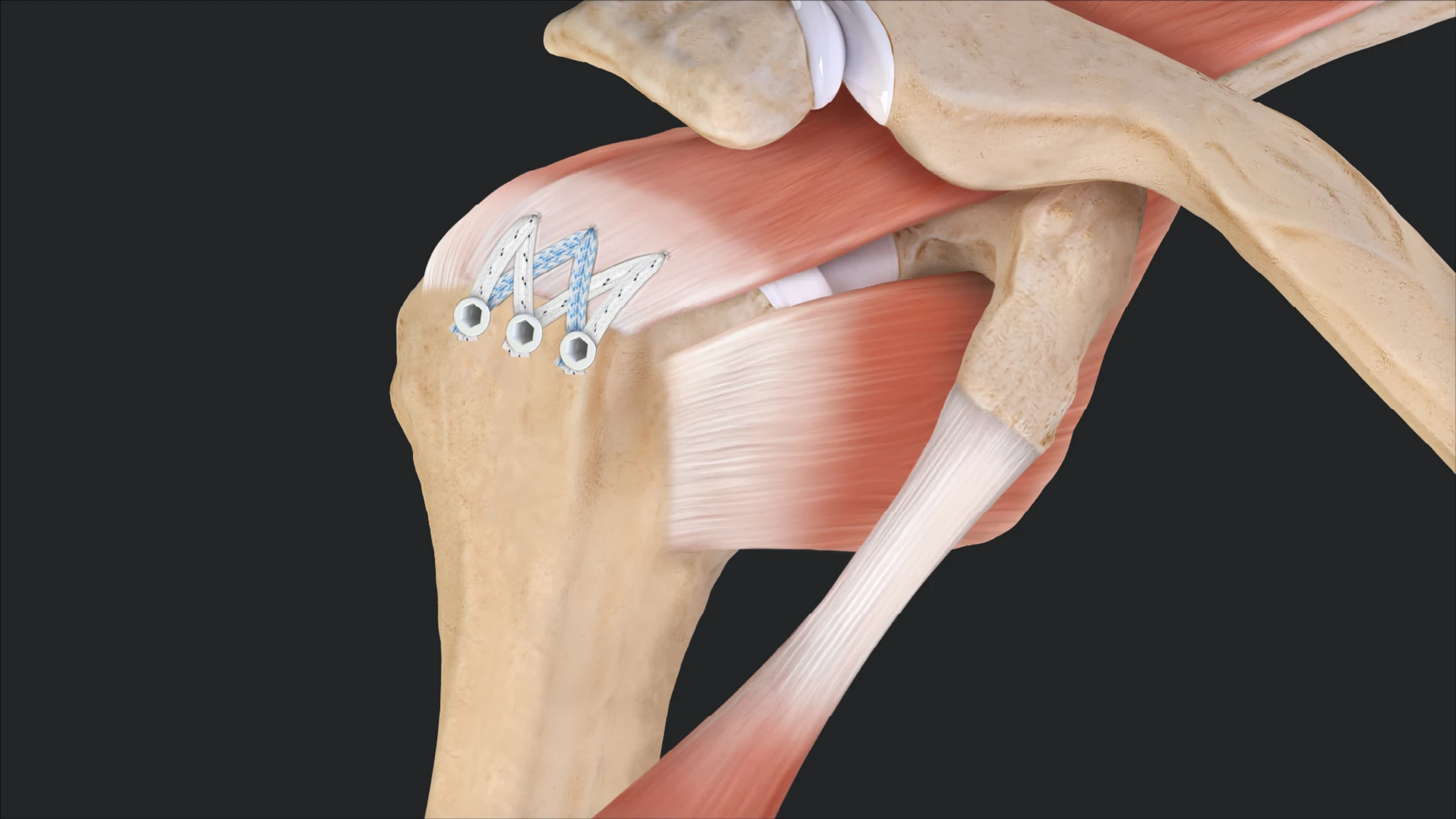
I perform all rotator cuff repairs arthroscopically, through small incisions with a camera. Anchors placed flush with the bone hold sutures that bring the tendon back down to its footprint so it can heal there. The operation usually takes 45 to 60 minutes and you go home the same day. For larger or weaker tendons I may use a stronger construct or a graft patch. In a comparison of two repair methods for large and massive tears with limited tendon mobility, complete healing was seen in 53% of load-sharing rip-stop repairs versus 11% of single-row repairs (Noyes 2019, PMID 31350083).
The tendon takes about 12 weeks to heal into bone, so recovery is the long part. See rotator cuff repair recovery, week by week for the full timeline.
Dr. Patrick J. Denard is a fellowship-trained shoulder surgeon and the founder of Oregon Shoulder Institute in Medford, Oregon. He has performed more than 10,000 shoulder surgeries. PubMed lists more than 300 of his peer-reviewed papers, over 130 of them on the rotator cuff, and he co-authored the 2016 arthroscopic superior capsular reconstruction technique papers with Dr. Stephen Burkhart and Dr. Christopher Adams. Expertscape ranked him #2 in the world for rotator cuff repair in 2021 and seventh in the world in 2023.
No. A full-thickness tear doesn't reattach to the bone by itself. It may stay the same size or get larger. Therapy can still relieve pain and improve strength, so many people do well without surgery, especially if they are older or less active.
Age is one factor, not a cutoff. Dr. Denard nearly always suggests therapy first for people over 70, but he considers repair if therapy doesn't help or if the tear came from a recent injury. Your health and goals matter as much as your birthday.
For a tear from an injury, Dr. Denard generally recommends repair within 3 months. For a tear that came on gradually, he recommends deciding within about 6 months of starting treatment, because muscle wasting after that point is not considered reversible.
Yes. Dr. Denard performs rotator cuff repairs arthroscopically, through small incisions with a camera. The operation usually takes 45 to 60 minutes and patients go home the same day.
Not necessarily. In one study of 86 massive tears, 88% were fully repairable at surgery (Sheean 2018, PMID 29273256). Muscle quality and arthritis on the MRI help predict which ones can be repaired.
If you already have an MRI, Dr. Denard can review your images and report remotely and send you a narrated video explaining what he sees and what he would recommend, typically within 48 hours, for $250. Start a remote MRI review. To be seen in person in Medford or Grants Pass, request an appointment or call 541-608-2595.
This page is for education and is not a substitute for an exam. Study results describe groups of patients and are not a guarantee of any individual result.
Keep reading
Oregon Shoulder Institute
rotator-cuff-repair-outcomes-dr-patrick-denard
Oregon Shoulder Institute
rotator-cuff-repair-recovery-week-by-week
Oregon Shoulder Institute
irreparable-rotator-cuff-tear-superior-capsular-reconstruction
Oregon Shoulder Institute
failed-rotator-cuff-repair-revision-options
Book a consultation in Medford or Grants Pass, or send your MRI for a second opinion from anywhere in the country.